
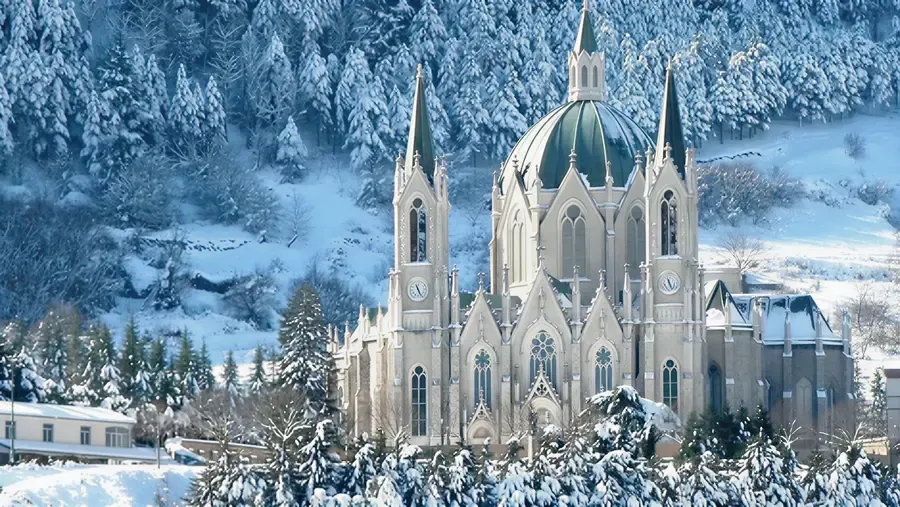
Perched on the slopes of Monte Patalecchia at around 800 metres above sea level, the Minor Basilica of Maria Santissima Addolorata di Castelpetroso (Our Lady of Sorrows) is one of the most important Marian shrines in southern Italy, and has been the patroness of Molise since 1973. Each year it draws hundreds of thousands of pilgrims from across Italy and abroad. Yet it’s also a place of remarkable architectural and natural beauty, worth a visit regardless of faith.
The story: the 1888 apparitions
It all began on 22 March 1888, the Thursday before Palm Sunday, when two peasant women from Guasto — a hamlet of Castelpetroso — Fabiana Cicchino (known locally as Bibiana, aged 35) and Serafina Valentino (aged 34), went to a place called “Cesa tra Santi” to work the land, taking two sheep with them. When one of the animals strayed, Fabiana found it in front of a rocky crevice from which an unusual light was shining. Drawing closer, she saw the Virgin Mary with the body of the dead Christ lying at her feet, her heart pierced by seven swords. Serafina, who came running up, saw nothing at first: she had to wait until Easter Sunday, 1 April 1888, to witness the apparition herself.
Word spread quickly. On 26 September 1888 the Bishop of Bojano, Monsignor Francesco Macarone Palmieri, travelled to the sacred site to investigate the reported apparitions — and, according to witnesses, he too was granted the grace of seeing Our Lady of Sorrows.
Another decisive event took place in November 1888: Carlo Acquaderni, director of the Marian periodical Il Servo di Maria and brother of one of the founders of Italian Catholic Action, made a pilgrimage to the site with his 12-year-old son Augusto, who was suffering from bone tuberculosis, considered incurable at the time. The boy drank from the spring that had gushed forth at the site of the apparitions, and recovered. It was Acquaderni himself who then launched the fundraising campaign for the construction of the sanctuary.
The foundation stone was laid on 28 September 1890, in the presence of some 30,000 people, to a design by the Bolognese engineer Francesco Gualandi. Works dragged on for nearly a century, owing to financial difficulties and the two World Wars: the basilica was finally consecrated on 21 September 1975 by the Bishop of Campobasso-Boiano, Monsignor Alberto Carinci. Two years earlier, on 6 December 1973, Pope Paul VI had already proclaimed Our Lady of Sorrows of Castelpetroso the patroness of Molise.
In 1995 the sanctuary received a visit from Pope John Paul II (on 19 March, the feast of Saint Joseph), and in 2013 it was elevated to the rank of Minor Basilica by Pope Francis, who then visited it on 5 July 2014 to meet the young people of Abruzzo and Molise.
The architecture
The sanctuary is an architectural surprise in the middle of the Molisan mountains — some compare it to a “fairy-tale castle” and, especially when covered in snow, to the castle from Frozen. The basilica is built in local limestone in a neo-Gothic style inspired by French Gothic, with two bell towers flanking a tripartite façade decorated with a large central four-light window and side three-light windows.
The plan is radial, with seven arms/chapels arranged around the central dome, which stands 54 metres high: the seven chapels symbolise the Seven Sorrows of Mary (the seven swords that pierce her heart in the apparition). The mosaics at the base of the dome portray the saints most venerated in Molise.
In the main chapel stands the altar in polychrome marble surmounted by the Throne, a richly decorated neo-Gothic marble canopy that houses the wooden statue of Maria Santissima Addolorata (the current sculptural group dates to 1963). In the seventh chapel a relic (a tooth) of Saint Gabriel of Our Lady of Sorrows has been kept since 1994. In the choir loft are the 1,778 pipes of the Ruffatti organ, built by the Ruffatti Brothers of Padua in 1993.
Also worth noting is the bell concert, cast by the historic Pontifical Marinelli Foundry of Agnone, in Molise itself.
The Via Matris and the Chapel of the Apparitions
One of the most atmospheric experiences — and one often missed by rushed visitors — is the Via Matris, the 750-metre path that climbs from the basilica up the mountain to the site of the apparitions. Don’t confuse it with a Via Crucis (Way of the Cross): the Via Matris has seven stations, not fourteen, and each one represents one of the Seven Sorrows of Mary — not the Passion of Christ. It was inaugurated in 1947 and each station is marked by a bronze sculptural group of considerable artistic quality.
The path ends at the Chapel of the Apparitions, blessed on 27 September 1947 by Monsignor Carinci: a small all-stone church with a broad porch, housing a painting of Our Lady of Sorrows made in 1948 by Mario Barberis. A short distance away you’ll also find the miraculous spring — the same one from which Augusto Acquaderni drank in 1888.
Allow 30–40 minutes to walk the Via Matris at a gentle pace. No special clothing is needed, but comfortable shoes are advisable — the ground is uneven in places. If you have difficulty walking, a second small car park allows you to drive up closer to the Chapel of the Apparitions.
On the 22nd of every month (the monthly anniversary of the apparition), the Via Matris is walked in solemn procession: 5:30 pm in summer, 3:30 or 4:00 pm in winter.
How to get there from Isernia
Castelpetroso is about 15–16 km from Isernia, but the sanctuary lies some 5 km from the village of Castelpetroso itself — reckon on 20–25 minutes by car from our accommodation.
By car: from the SS17 in the direction of Campobasso/Benevento, take the SP 52 / SP 36 / SP 37DIR towards Castelpetroso, following signs for the Santuario. Signage is clear. There’s a large free car park at the main forecourt, suitable for motorhomes too. A second small car park is available higher up, near the Chapel of the Apparitions.
By public transport: from Isernia’s Piazza della Repubblica stop, the line 026 bus runs to the “Bivio Santuario Castelpetroso” stop. From there it’s about a kilometre on foot (uphill) to the basilica. Total journey around half an hour — but services are infrequent, so the car remains by far the most practical option.
A note: the road up to the sanctuary has a few hairpin bends — no problem in normal conditions, but in snow or ice winter tyres are advisable (they are in any case legally required in Molise from 15 November to 15 April).
Opening hours and practical information
- Basilica opening hours: daily, summer 6:45 am – 8:30 pm, winter 6:45 am – 7:30 pm
- Admission: free
- Weekday Masses: 7:00 am, 11:30 am* (*may vary), 5:00 pm
- Sunday and holiday Masses: 8:30, 10:30, 12:00, 5:00 pm, 6:30 pm
- Confessions: weekdays 9:00 am–12:30 pm / 4:00–6:30 pm — Sundays 8:30 am–1:00 pm / 4:00–7:30 pm
- Rosary: daily at 4:20 pm
- Eucharistic Adoration: Thursdays at 4:00 pm
- Car park: free and ample
- Basilica office: tel. +39 0865 936110 (9:00 am–12:30 pm / 4:00–6:00 pm) — official website santuarioaddolorata.it
Busiest times: 22 March (anniversary of the first apparition), any solemn celebrations on the third Sunday of March, 15 September (liturgical feast of Our Lady of Sorrows), 26 September (anniversary of the apparition to Bishop Palmieri), and the last Sunday in September (anniversary of the laying of the foundation stone). At these times expect crowds and be prepared to park further away.
Nearby: what to combine your visit with
The village of Castelpetroso (5 minutes)
Five kilometres from the sanctuary, the medieval village of Castelpetroso (at 872 metres altitude) is worth a stop in its own right. It still has three intact town gates (Porta del Parco, Porta Pistiello, Porta Macchietelle), the parish church of San Martino Vescovo from the 13th century (whose portal echoes that of San Francesco in Isernia, and which houses paintings by Molisan master Amedeo Trivisonno), and the de Rossi Marquisal Palace-Castle, of Lombard origin, which holds an artistic Molisan nativity scene in 18th-century costumes.
Altilia–Saepinum (about 45–50 minutes)
If you’d like to combine the sacred with the ancient, Saepinum (at Altilia, province of Campobasso) is the most spectacular Roman archaeological site in Molise — so much so that it’s been nicknamed “the little Pompeii of Molise”. A Roman town of middling importance, it has survived intact precisely because no modern city was ever built over it. Highlights include the Roman theatre (capacity 3,000), the forum, the basilica with its twenty Ionic columns, the macellum (market), and above all the monumental Porta Bojano with inscriptions recording Drusus and Tiberius as the funders of the walls.
Good news: from 1 March 2026, admission to the Sepino Archaeological Park is temporarily free, owing to PNRR-funded works on certain areas. Normally the combined ticket for the archaeological area and museum costs €10 (reduced €2). Check parcosepino.it for updates.
Bojano (25 minutes)
The historic seat of the Campobasso-Boiano diocese to which the sanctuary belongs, Bojano sits at the foot of the Matese massif. It was once one of the capitals of the Samnite people (the ancient Bovianum) and today preserves stretches of polygonal walling, a medieval castle in a panoramic position, and a small but interesting archaeological area. Worth an hour’s stop.
Campitello Matese (40 minutes)
If you plan to pair your visit to the sanctuary with a day of skiing (winter) or hiking (summer) in the Matese mountains, Castelpetroso is practically on the way.
Tips for visiting
Dress code: as a place of worship, modest dress is required inside the basilica (shoulders and knees covered). Shawls are available at the entrance if needed.
Photography: permitted both inside and outside the basilica without flash, but not during religious services.
With children: the sanctuary is family-friendly. The car park is large, the Via Matris walk is a bit demanding but atmospheric, and the Chapel of the Apparitions is fascinating for younger visitors too.
Pilgrim’s House: next to the sanctuary, the Casa del Pellegrino offers accommodation with Casa Vacanze, half-board and full-board options — useful for those wishing to spend several days in prayer or contemplation.
Our accommodation in Isernia is about 20 minutes from the sanctuary — an ideal base for an unhurried visit. Check availability →