
The historic centre of Isernia is best explored on foot, at a leisurely pace. It’s neither a chaotic maze nor a museum-piece town — it’s a living place, with bars and shops tucked between noble palaces and medieval churches. This itinerary takes you from the best-known landmarks to the quieter corners, in about 2–3 hours of unhurried walking.
Starting point: Piazza Celestino V and the Fontana Fraterna
The heart of the historic centre is Piazza Celestino V, with the celebrated Fontana Fraterna at its centre. It’s the first place to stop — and the best spot to get your bearings.
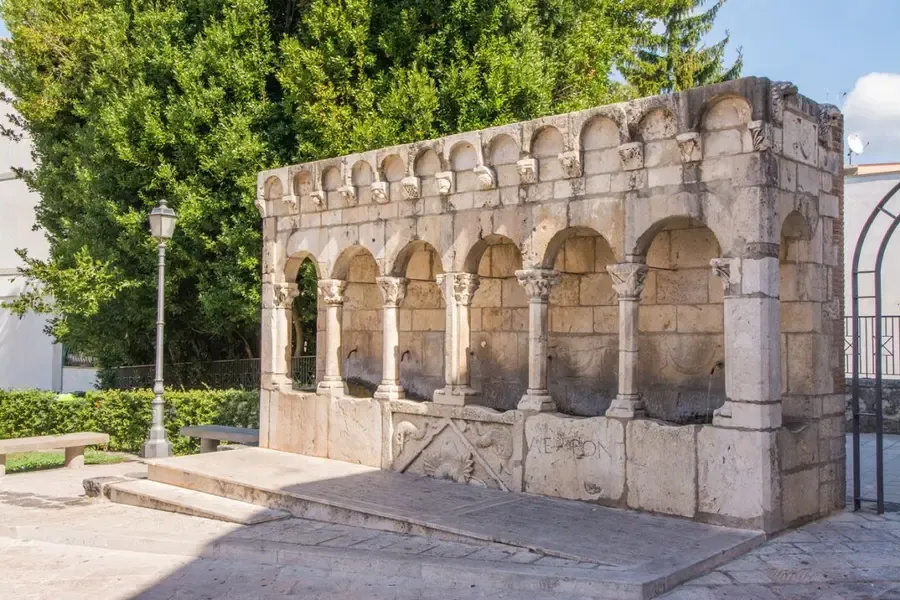
The fountain takes its name from the fact that it stands in the same district that once housed the Confraternity founded in 1289 by Pietro Angelerio, the future Pope Celestine V. The current structure, however, was built in 1835 by the noble Isernia family Rampini (their coat of arms featuring a hooked cross is still visible on the right-hand side, alongside the inscription FONS ISTE / CUIUS POSIT / RAMPINIANI / ME PARABIS). It wasn’t built from scratch: it emerged from the fusion of two pre-existing fountains — one near the atrium of the Cathedral, the other already standing in Largo Concezione — assembled from blocks of limestone of various periods recovered from an unknown number of buildings across the city.
Look closely at the inscriptions: some of the slabs are Roman (such as the one bearing the letters AE PONT, and a funerary inscription dedicated to the Manes), while others are medieval, including an early medieval epigraph on the right side referring to the construction of a fountain, set between two lion-head reliefs. The upper tier is decorated with twelve hanging arches supported by small corbels, each one carved differently, with zoomorphic, floral and geometric motifs.
The fountain has had a turbulent history: in 1889 it was moved further down, onto Corso Marcelli, where it remained until 10 September 1943, when the Allied bombing of the city destroyed it. It was faithfully rebuilt in the years that followed using the recovered pieces, and eventually returned to its original setting in Piazza Celestino V. In 1977 the Italian postal service dedicated a 120-lire stamp to it, and today the Treccani Encyclopedia lists it among the finest fountains in Italy.
Visiting hours: always visible, as it stands in an open public space.
Along Corso Marcelli: the commercial heart
From Piazza Celestino V, Corso Marcelli — the ancient cardo maximus of the Latin colony of Aesernia — runs through the historic centre like its backbone. This is where the city’s everyday life was once concentrated: cafés, grocers, a couple of bookshops, pharmacies, with the market just around the corner.
As you walk along the corso, look up: the upper floors of the palaces show 17th- and 18th-century windows that no renovation has yet touched. The ground-floor shopfronts conceal historic façades of real interest. Along the way you’ll also come across stretches of polygonal walling and Latin inscriptions set into the masonry — witnesses to more than two thousand years of urban life.
The Cathedral of San Pietro Apostolo and Piazza Andrea d’Isernia
Continuing along the corso, you reach Piazza Andrea d’Isernia (also known as Piazza Mercato), dominated by the Cathedral of San Pietro Apostolo, the principal place of worship of the diocese of Isernia-Venafro. The square has been dedicated since 1871 to the jurist Andrea d’Isernia (Isernia, c. 1230 – Naples, 1316), considered the city’s most illustrious son: a professor of civil law at the Neapolitan Studium, known for his work on feudal legislation, he earned the honorary title of monarcha feudistarum, “king of the feudists”.
The Cathedral stands on an ancient Italic temple of the 3rd century BC, dedicated to the Capitoline Triad (Jupiter, Juno, Minerva), the travertine podium of which is still visible along the flank facing Corso Marcelli. The current building is the result of numerous reconstructions following successive earthquakes — in particular those of 1349, 1456 and above all the devastating earthquake of 1805, after which the church was rebuilt on a larger scale between 1826 and 1851. The façade is now neoclassical, with a large 19th-century pronaos supported by Ionic columns and a triangular travertine pediment, commissioned by Bishop Gennaro Saladino.
The interior has three naves with pillars decorated by Corinthian pilasters in polychrome marble, an 18th-century dome and side chapels of considerable interest. Don’t miss the Chapel of the Blessed Sacrament with its Byzantine icon of the Virgo Lucis (Our Lady of the Light), brought to Isernia in 1567, and the 13th-century statue of the Madonna del Piede (Our Lady of the Foot). But the most striking feature is the glass floor, installed after the 1943 bombing and the restorations of the 1960s: through it you can see the archaeological remains of the Italic temple beneath.
Built against the left flank of the church, above Corso Marcelli, stands the old bell tower — commonly known as the Arco di San Pietro (Arch of Saint Peter), because of the large ogival arch through which the corso itself passes. It’s one of the city’s most photographed landmarks.
The Diocesan Museum
Inside the Bishop’s Palace, which adjoins the Cathedral at Piazza Andrea d’Isernia 2, you’ll find the Diocesan Museum. The collection includes sacred furnishings, vestments, stone sculptures and goldsmith works of various periods. Note that the museum has been undergoing refurbishment and restoration of its silver collection: it’s worth ringing the diocese or asking at the Cathedral to check opening arrangements before your visit.
Porta Mercato and the polygonal walls
On one corner of Piazza Andrea d’Isernia you’ll notice an old stone structure that seems oddly isolated from its surroundings: this is Porta Mercato, one of the city’s historic gates, opening onto the ancient western walls. Its shape resembles a low tower, with a double arch reached by a short flight of steps — it once led directly to the Roman forum where the market was held.
Heading towards via Occidentale along vico Storto Marilli, you reach Porta Castello, another surviving gateway in the old walls. Here a few leafy trees frame a stone arch that opens onto a small garden nestled against the walls. Around these stretches of the circuit, the ground slopes down towards the valley — in these outer parts of the historic centre you’ll find unexpected glimpses of the countryside and the surrounding hills.
Palazzo San Francesco and the noble palaces
Walking back along the corso, away from the Cathedral, you reach Palazzo San Francesco, now the seat of the Town Hall, flanked by the Franciscan church of the same name (founded in 1222 by the will of Saint Francis of Assisi). The façade is divided into two orders and it’s one of the most important civic buildings in the historic centre.
In the side streets off the corso you’ll find a number of 17th- to 19th-century noble palaces. Most are private, but the façades and portals can be admired from the street. Worth a look: Palazzo Laurelli (d’Avalos-Laurelli), a neoclassical example built after the 1805 earthquake, wedged between the 3rd-century BC walls and the ancient cardo; Palazzo de Lellis Petrecca; and Palazzo Pansini-Clemente, built on the spot where tradition places the birthplace of Andrea d’Isernia himself.
Santa Maria delle Monache
Before rounding off the walk, it’s worth heading down to the monumental complex of Santa Maria delle Monache, a former early medieval Benedictine convent that today houses the Archaeological Museum (reopened on 1 August 2022), whose collection tells the story of the city from the archaic period through to the Middle Ages, including a section dedicated to the Italic Sanctuary of Pietrabbondante. The complex is also home to the National Palaeolithic Museum, which displays finds from the prehistoric site of Isernia La Pineta — including the famous tooth of a Homo heidelbergensis child who lived around 600,000 years ago.
Archaeological Museum opening hours: Tuesday to Sunday, 8:15–13:45. Standard ticket €3.00; combined with the Palaeolithic Museum €5.00. Check for updates on the website of the Molise Regional Museums Directorate.
Where to stop for a bite
Bars and cafés along the corso: a morning coffee in one of the historic bars in the centre is an experience in itself — freshly baked cornetti, strong Neapolitan-style coffee, and no sense of rush.
Trattorias: the historic centre has a handful of trattorias serving traditional Molisan cuisine. Look for places without laminated menus in the window — the best ones still have a chalkboard or tell you the dishes by heart. Not to be missed:
- Pallotte cacio e ova: cheese-and-egg dumplings, a dish shared with neighbouring Abruzzo
- Bean soup with pork rind: the quintessential winter dish
- Roast lamb or abbacchio alla molisana in the colder months
To accompany your meal, consider a glass of Pentro di Isernia DOC — the local wine produced on the surrounding hills, available in red, white and rosé (the reds are based on Montepulciano and Sangiovese grapes).
A coffee with a view: the Belvedere
Before heading back to the car park or your transport, make your way up to the panoramic spots in the upper part of the historic centre. From there, the view opens out over the Isernia valley, the surrounding hills, and on clear days the mountains of the Matese and the Mainarde ranges.
Our accommodation is a 10-minute walk from the historic centre. If you’d like to explore Isernia without the hassle of parking and timings, we’re the ideal starting point. Book your stay →