
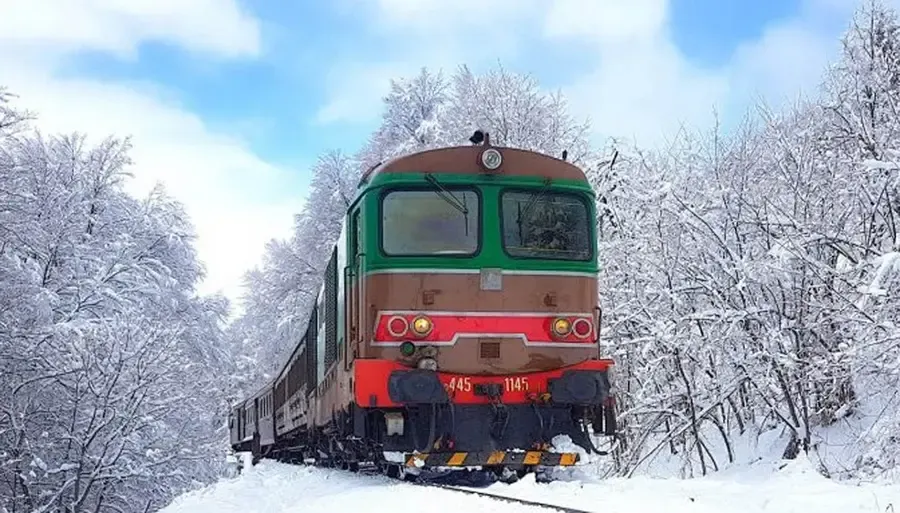
There’s a train that crosses the central-southern Apennines, winding through forgotten villages, dizzying viaducts and snow-covered forests. It’s not in Siberia — it’s in Italy, along the historic Sulmona–Isernia line, today officially known as the Ferrovia dei Parchi (Railway of the Parks) and popularly as the Transiberiana d’Italia.
What is the Transiberiana d’Italia?
The Sulmona–Isernia railway, 128.73 km long, was designed at the end of the 19th century to link the Adriatic to the Tyrrhenian coast across the Apennines. The first section, Sulmona–Cansano, opened on 18 September 1892, while the entire line was inaugurated on 18 September 1897, after five years of works through forests, valleys and gorges. At Rivisondoli–Pescocostanzo station, the line reaches 1,268.82 metres above sea level: the second-highest railway station in Italy on the standard-gauge network, after Brennero (1,371 m).
The nickname “Transiberiana d’Italia” first appeared in November 1980 in the magazine Gente Viaggi, in an article by journalist Luciano Zeppegno, who compared the snow-covered Abruzzo plateaus to the Siberian steppe.
After regular services were suspended in December 2011, the line faced permanent closure. Its revival is down to the Le Rotaie association (which organised the first special trains as early as March 2012) and the Fondazione FS Italiane, which included the line in the “Binari senza tempo” (Tracks Beyond Time) project in May 2014. Since 2016, the Ferrovia dei Parchi has been Italy’s most popular tourist railway, with over 40,000 visitors in 2022. In 2017, Law 128 formally established and protected Italian heritage railways.
The route: what you see from the window
The train always departs from Sulmona station (328 m asl), a town in Abruzzo’s province of L’Aquila famous for its sugared almonds (confetti), and climbs gradually towards the Altipiani Maggiori d’Abruzzo (Great Plateaus of Abruzzo), passing through:
- Pettorano sul Gizio — medieval hilltop village at the foot of the Majella National Park
- Cansano and Campo di Giove — in the heart of the Majella
- Palena — with its Aventino river springs
- Rivisondoli–Pescocostanzo — the highest point, often snow-covered even in spring
- Roccaraso — renowned ski resort
- Castel di Sangro — town with a medieval castle
- Alfedena, Scontrone — small Apennine villages
- San Pietro Avellana and Carovilli — already in Molise
Beyond the Monte Pagano tunnel (3,109 metres, the longest on the line), the train enters Molise through Carpinone and the Volturno valley, down to the historic terminus of Isernia. Along the route the line runs through 58 tunnels (25 km underground in total), across 103 main viaducts and bridges, and past 21 stations.
In winter, under the snow, the route is surreal: viaducts rising out of the mist, white forests, villages frozen in time. In autumn, the Apennine foliage is among the finest in Italy. In spring and summer, flowering meadows, pastures and still-snow-capped peaks.
Important: currently, the heritage trains depart from Sulmona and do not reach Isernia (or Carpinone) because of ongoing electrification and station-upgrade works on the Molisan stretch, funded by the Italian PNRR programme. Current itineraries go as far as Roccaraso, Castel di Sangro or Carovilli (in Molise), with a same-day return to Sulmona.
2026 calendar: when the heritage train runs
Transiberiana d’Italia heritage trains do not run every day: the service is seasonal, concentrated at weekends and on public holidays (Christmas, Easter, bank-holiday weekends).
Winter 2026 timetable (Snow Trains)
From Saturday 10 January to Sunday 15 March 2026 — every Saturday and Sunday, departing from Sulmona towards Roccaraso, Castel di Sangro or Carovilli.
Spring 2026 timetable
From 29 March to 2 June 2026 — weekends and bank holidays, with itineraries dedicated to the spring bloom, local food festivals and Abruzzo’s villages. Bookings open: Monday 16 February 2026.
Summer, autumn, Christmas markets
Seasonal calendars are published at the start of each season on the official website. The Christmas Market period (late November – 6 January) and the winter snow season are the most sought-after: they often sell out within hours.
Transiberiana d’Italia 2026 ticket prices
Prices vary depending on the itinerary, the season and included services. Indicative prices for 2026:
- Adults (13+ years): €50–€75 return
- Children 4–12 years: €30–€35
- Children 0–3 years: free (if not occupying a seat)
- Full packages with accommodation, shuttles and guided tours: €165–€265 per person
The ticket includes the historic train journey, onboard music or theatre entertainment and a guide service. It does not include lunch (packed or at partner restaurants) or any extra guided tours in the villages.
How to book your tickets
- Official website: ferroviadeiparchi.it — the only direct channel for buying tickets
- RailBook: railbook.it — authorised partner platform
- Pallenium Tourism: official tour operator for full packages (hotel + train)
Booking procedure:
- Check the calendar on the official website (dates published 1–3 months in advance)
- Choose your date, number of seats and itinerary
- Pay online by credit or prepaid card
- Receive your ticket by email
Note: tickets cannot be bought at stations, nor at Trenitalia automatic ticket machines, nor at non-partner travel agents. Beware of unofficial websites.
Our tip: book at least 6–8 weeks in advance for winter and Christmas dates. For the spring 2026 calendar, bookings open on 16 February 2026; many seats sell out within hours.
The heritage carriages
Heritage trains use restored period carriages:
- Centoporte (“hundred doors”) — iconic 1920s Italian State Railway carriages with wooden interiors (the most photogenic)
- Corbellini — 1950s carriages, also rich in wood panelling
- Traction is mostly historic diesel (D445 “Bombardone” locomotives or class 940). Steam trains with class 740 or 625 locomotives are used for special events and sell out fast
Onboard there’s a free luggage van for bicycles, prams, skis and sledges. Small dogs (up to 20 kg) are welcome on a lead, at no extra charge.
Getting to Sulmona from our Casa Vacanze in Isernia
Important note: since the heritage train currently departs from Sulmona and does not yet reach Isernia (electrification works in progress), to board the Transiberiana d’Italia you need to make your way to Sulmona. From our place in Isernia:
- By car: about 1 hour 45 minutes (~130 km) via the SS17 and A25 motorway (exit at Pratola Peligna–Sulmona). Sulmona station has a large free car park available all day
- By Trenitalia train: there is currently no direct Isernia–Sulmona service; you’d have to change at Rome or Pescara (6–11 hours — not practical)
- By bus: some regional routes link Isernia and Sulmona, but timetables don’t match the heritage train departure (8:45–9:00 am from Sulmona)
The practical solution: use our Isernia base to explore Molise (villages, Castelpetroso, Pietrabbondante), and set aside one dedicated day for the Transiberiana, leaving early by car for Sulmona. Alternatively, spend the night before in Sulmona itself.
Looking ahead: once the PNRR works are completed, heritage trains are expected to return as far as Isernia — at which point our property, 5 minutes from the station, will be the ideal starting point.
What to pack for the trip
- Winter: layers — the train is heated, but the stops at mountain stations can be freezing (Rivisondoli–Pescocostanzo is easily below zero)
- Camera or smartphone: the route is one of the most photogenic in Italy; watch out for window reflections
- Packed lunch or restaurant booking: onboard there’s at most a small bar service
- Ticket (digital QR or printed): checks are strict
- Comfortable shoes: for stops and village walks
Highlights along the route
Pescocostanzo
One of the most beautiful villages in Italy (Borghi più Belli d’Italia), a short distance from Rivisondoli–Pescocostanzo station. A 16th-century old town with the Collegiata di Santa Maria del Colle and historic goldsmith and bobbin-lace workshops.
Roccaraso
The main ski resort in central-southern Italy, excellent if you want to combine Transiberiana and skiing in the same weekend. The Alto Sangro–Aremogna ski area has over 100 km of pistes.
Castel di Sangro
A town with a medieval castle on the Civita hill, the church of Santa Maria Assunta, and a modern auditorium. 20 minutes from Roccaraso.
Carpinone (Molise)
A small Molisan village with the Caldora–Pandone castle and the nearby Carpinone waterfalls, one of the region’s most-loved nature spots.
FAQ — Transiberiana d’Italia questions answered
How long does the trip last? Between 8 and 10 hours in total, including village stops. Sulmona to Roccaraso takes around 2h30 of actual railway time; the return follows the same route.
Can you take the train one-way only? No: the service is always a same-day return, departing from and returning to Sulmona.
Are the trains accessible for wheelchair users? Some stations and heritage carriages have difficult access. It’s essential to contact Ferrovia dei Parchi in advance to check availability and accommodations.
Can you bring a bike? Yes, there’s a free luggage van for bicycles, skis, sledges and prams. Always confirm for the specific event, though.
What happens if there’s heavy snow? The line is equipped with avalanche shelters and protective walls. In extreme weather a cancellation may be announced, with full refund of the ticket.
Are the Christmas Train and the Snow Train different? The Christmas Market Train (22 November 2025 – 6 January 2026) includes visits to Christmas markets in the villages. The Snow Train (10 January – 15 March 2026) is for the winter season proper, with optional skiing and snowshoeing activities.
Our guesthouse in Isernia is the ideal base for exploring Molise and planning a day on the Transiberiana d’Italia departing from Sulmona. Check availability →